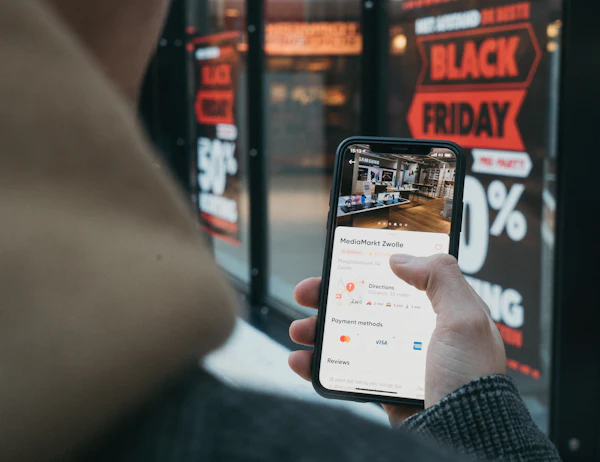
Black Friday falls on Friday, November 27, 2026. You have eleven days left. Your campaigns will attract a surge of visitors, most of whom will leave without buying anything and without leaving a trace. A well-tuned e-commerce email capture form changes this equation: every visit paid for at full price can become a contact you can re-engage with for free in December, January, and beyond.
The problem is that many stores add a "-10%" pop-up the day before. They collect mistyped addresses and code hunters, and lose these subscribers from the very first email. This guide shows you what you can still set up this week, then how to keep these contacts after the holidays.
The short answer: effective ecommerce email capture comes down to five settings: a clear incentive (discount, early access or useful content), a trigger after a sign of interest rather than on arrival, the email field followed by one or two preference questions, an unticked consent box, and a welcome sequence sent within a minute. All of it takes less than a week of work.
Which signup incentive to choose: discount, content or early access?
Before Black Friday, early access is often the most effective offer for capturing e-commerce emails. It provides a reason to sign up now, without adding a welcome discount on top of already slashed prices.
Each incentive attracts a different profile. So the choice is not made on gut feeling, but based on your margin and the customer you want to see again in February.
| Offer | Strength | Risk | Ideal for |
|---|---|---|---|
| Welcome discount | High registration volume | Bargain hunters, circulating codes, combined with Black Friday prices | Small basket, strong price competition |
| Early access (24 hours in advance) | Real urgency, no extra margin sacrificed | Requires a real head start over the public opening | Limited stock, brand with a community |
| Useful content (gift guide, quiz) | Qualified contacts, preference data | Less immediate promise | Thoughtful purchase, high basket |
On r/shopify, several merchants describe the same side effect. The first-order discount inflates the list, but some subscribers only buy once, with a small cart, and then stop opening emails. Some have replaced this code with priority access to new products and say they are acquiring better customers.
If you're keeping a discount, generate unique, one-time-use codes. A generic code quickly ends up in browser extensions that list coupons. For other benefits besides a discount, see our selection of lead magnet ideas to capture leads offers twelve formats you can test.
Popup, embedded form or product quiz: which ecommerce email capture format?
The popup captures the most volume, the embedded form attracts the most intentional visitors, and the product quiz gathers preferences. The most cost-effective approach often combines two of these formats.
The popup: it adds volume, provided it doesn't hide the page
The popup remains the most visible format. On mobile, however, it must keep the content accessible. Google recommends, in its Search Central documentation, avoiding interstitials that cover the entire page and instead opting for windows or banners that only occupy a portion of it.
In practice: a visible close button, a single field on the first screen, and a button that restates the promise (“Get my early access”) rather than a flat “Submit”.
The embedded form: fewer views, higher intent
A block placed on the product page ("Get notified about the Black Friday price"), on the category page, or in the empty shopping cart reaches visitors who are already engaged. It converts fewer sessions, but its subscribers buy more often. Placed alone in the footer, it remains discreet: a merchant on Reddit sees about ten sign-ups per month via the footer, compared to several per day with a pop-up.
The product quiz: capture that qualifies
“Find the perfect gift in 4 questions” turns entering an email into a useful step: visitors give it to receive their selection. It's the ideal format for large catalogs. Our guide to the lead generation quiz explains how to build one.
With Blastform, the same form can be deployed in three ways: a full HTML page, a block embedded in a page, or a pop-up. This lets you test several placements without rebuilding everything.
When to trigger your ecommerce email capture form?
Never in the first second. Trigger it after a signal of interest: a few seconds of reading combined with scrolling, a second page viewed or exit intent.
Here's why. A visitor who hasn't yet seen any products has no reason to give you their address. The triggers that work best:
- Combined delay and scrolling: for example 5 seconds and 20% of the page viewed.
- Second page viewed the visitor has already shown an interest in your catalogue.
- Exit intent on desktop: last chance before the visitor leaves.
- Exclusions: never in the checkout funnel, never for a subscriber arriving from one of your emails.
- Frequency cap: a visitor who has closed the window should not see it again for several days.
The figures confirm what's at stake. In an article published in August 2026, Klaviyo cites a benchmark submission rate of 3%. Its audits find 3 to 8% for a standard welcome popup, and 10 to 13% for an exit form. The author insists: these settings matter more than the choice of format itself.
One or two preference questions to segment from signup
In an e-commerce email capture form, add a maximum of two clickable multiple-choice questions, right after the email. They have a low conversion cost and prevent you from sending the same Black Friday message to your entire list.
The most useful ones in e-commerce:
- Are you buying this for yourself or as a gift?
- "Which category interests you the most?" (three or four buttons, no drop-down list)
- "What gift budget are you aiming for?" if your catalogue covers several price ranges.
More questions, fewer sign-ups? Not necessarily. Klaviyo reports the case of a baby care brand that tested 30 versions of its form: asking who the visitor was buying for converted better than the shortest version. The key lies in the format: email on the first screen, questions afterward, only one per screen.
A well-constructed conditional logic refines the journey even further: the question "for whom?" only appears if the visitor answered "as a gift". Then monitor drop-off at each step. If a question causes submissions to fall, our checklist for auditing overly long forms helps you decide.
One last, often overlooked point: address quality. The real-time email verification offered by Blastform flags typos such as “gmial.com” before submission. Responses then go to your email marketing tool, for example via the integration between Blastform and Zapier, to feed your segments.
For an overview of these journeys, from sign-up to the exclusive offer, see our dedicated page on e-commerce forms and lead nurturing.
CNIL consent: what your form must display
In B2C, sending marketing emails requires the recipient's prior consent. This is achieved through a positive action: an unchecked box, clear text, and a simple unsubscribe link in each email.
The CNIL fact sheet on email marketing sets the rules. Consent must be freely given, specific, informed, and unambiguous. Your e-commerce email capture form must therefore display:
- a dedicated box, unchecked by default, separate from the acceptance of the terms and conditions;
- a separate box if you intend to share the address with partners;
- the identity of the store and its intended use ("offers, new products and early access");
- a link to your privacy policy;
- an unsubscribe link in every email sent.
And that's not all. A common misconception arises: the "customer" exception (soliciting a customer for similar products without their consent) assumes that a sale has already taken place. The CNIL (French Data Protection Authority) clarifies that simply creating an online account is not sufficient. A visitor who opens an account to follow their favorites, without making any purchases, does not fall under this exception.
Double opt-in is not required by this text, but it filters out incorrect addresses. Also keep proof: date, form source and the exact wording of the checkbox. The opt-in checkboxes and GDPR texts in Blastform can be customized, and our guide on forms and GDPR consent offers sample wording.
The welcome sequence that keeps your subscribers after the holidays
Send the first email within a minute, then three or four messages over two weeks, tailored to the form responses. This is where the value of each e-commerce email capture lies, far more so than in the Black Friday email.
Omnisend's 2025 dataset (over 27,000 brands) clearly demonstrates this. In its email marketing benchmarks, the automated welcome email achieves a 2.11% conversion rate. Traditional campaigns are capped at 0.08%. Its open rate (35.53%) also exceeds that of the campaigns (30.41%).
A simple sequence for the end of the year:
- Immediate: confirmation and promise kept (unique code or date and time of early access).
- Day 2: a selection based on the answer given. "For gifting" receives a gift guide by budget; "for me" receives products from the chosen category.
- Thursday, November 26: early access opening, 24 hours before everyone else.
- After Cyber Monday on November 30th: change of pace. Delivery times before Christmas, usage tips, customer reviews, no new promotions.
The thank-you page also extends the sequence. Thanks to conditional thank you pages with pixel, a "gift" subscriber lands directly on the gift selection, and your conversions flow cleanly back into your advertising tools.
The 11-day plan before Black Friday and the metrics to track
Eleven days is all it takes to launch a clean e-commerce email capture campaign, provided you finalize the setup two days before the peak. Here's the timeline, followed by the key metrics to track.
The day-by-day calendar
- Monday 16th and Tuesday 17th: choose the offer, write the consent checkbox, build the form from one of the B2C form templates.
- Wednesday 18: connect the email tool, write the immediate email, test on mobile.
- Thursday 19: put the popup and the product page block live, launch an A/B test on the hook.
- Friday 20th to Tuesday 24th: read the numbers every morning, cut the losing variant, adjust the trigger.
- Wednesday 25: freeze all changes.
- Thursday 26: early access for subscribers.
- From November 27th to 30th: capture continues, with a suitable promise (“Be notified of restocking”).
The metrics that matter
The submission rate alone is not enough to judge an e-commerce email capture. Also track address quality and how much revenue subscribers generate over 30 and 90 days.
- submission rate by format, page and traffic source;
- drop-off by form step;
- proportion of invalid or bounced addresses;
- unsubscribes during the welcome sequence;
- revenue per subscriber at 30 and 90 days, compared with non-subscribed visitors;
- share of November subscribers who still open your emails in February.
The last figure answers the real question: did you acquire contacts for one weekend or for the whole year? The features of Blastform cover the form side: A/B testing, conversion rate, step-by-step drop-off analysis and UTM tracking with Google Tag Manager.
Frequently asked questions
What is a good signup rate for an ecommerce popup?
Klaviyo uses a benchmark submission rate of around 3%. Its audits show rates of 3% to 8% for a welcome popup and 10% to 13% for an exit form. First, compare your results to your own historical data, broken down by format and traffic source.
Do popups drive shoppers away?
A pop-up displayed immediately upon arrival is annoying, especially on mobile. Triggered after a signal of interest, closeable with a single tap, and hidden for subscribers, it's much less intrusive. Measure revenue per session with and without pop-ups to make a decision based on your own data.
Do you have to offer a discount to collect emails?
No. Early access, a gift guide, or a product quiz attracts more qualified subscribers. Discounts generate more volume, but also more code hunters. If you offer one, use unique codes.
Can you send promotions to a visitor who created an account without buying?
Not without their consent. According to the CNIL (French Data Protection Authority), the customer exception requires a prior sale, and simply creating an online account is not enough. Add an unchecked opt-in box to the account creation form.
Black Friday only lasts a weekend, but well-run e-commerce email capture this week works for you all year long. Choose an offer, set the trigger, ask two questions and polish the first sequence. Want to validate your setup before November 27? Book a demo of Blastform or start your free trial to create your form today.